Ceramics Monthly: What drew you to East Fork, and how has your role here evolved over time?
Kate Johnson: I hadn’t heard of East Fork when I applied to the Mold Shop—I knew the pay and benefits were good. What made me stay was the environment they create, at work and in the community. People love East Fork for more than pottery; they love the sense of belonging that can’t be replicated.
I started in 2021 with no ceramic experience. East Fork taught me a highly technical craft, starting with pouring production molds and moving to prototyping, making polyurethane masters, slip casting, and creating RAM press dies. As a Mold Shop Technician, I understand our processes deeply and can confidently support new coworkers.
CM: What skills have you learned at East Fork that you think will stay with you, regardless of where your career goes next?
KJ: I’ve learned nearly all my technical skills at East Fork. The growth I’ve experienced over the past four years has shaped how I work in every part of my life. I’ve developed strong problem-solving abilities, physical endurance, administrative responsibility, and meticulous attention to detail—especially on projects where 40 hours of work can fail within minutes, and having to reset and start again. I’ve earned practical certifications in forklift and CPR, and gained hands-on skills in safely using sledgehammers, heavy machinery, and heavy lifting. But most importantly, East Fork gave me confidence that I can learn any craft, adapt quickly, and master new skills.
CM: What drew you to East Fork, and how has your role here evolved over time?
Emma Whitney: I was drawn to East Fork for many reasons. However, in the spirit of complete honesty, the starting pay was higher than most of the other jobs I would have been qualified for at the time. During my interview, it became evident that this company was dedicated to its craft in a similar way to my previous job in woodworking. I started at East Fork as a glaze generalist and quickly realized that this company offered far more than just a living wage; it is a business that truly values the growth of its employees. As I learned more about glaze setup and application, I was promoted to a glaze team lead. And as I learned more about kiln firings, rheology, and the function of the equipment we use daily, I moved away from the glaze team and into a materials technician role, gaining a technical understanding of glaze calculations, color and clay development, material interactions, process improvements, kiln firings, and so much more. My role is now focused on developing East Fork’s glaze colors and products.
CM: What skills have you learned at East Fork that you think will stay with you, regardless of where your career goes next?
EW: There are a plethora of technical and management skills East Fork has taught me over the years, from methods of data collection, recording, and interpretation to quick decision-making and on-the-job problem solving. East Fork has also taught me that success is rarely achieved alone. Instead, it’s achieved by uplifting those around you and showing up with compassion and an unwavering dedication to be the best that you can be.
We understand your email address is private. You will receive emails and newsletters from Ceramic Arts Network. We will never share your information except as outlined in our privacy policy. You can unsubscribe at any time.
Please enjoy this complimentary article for the month.
For unlimited access to Ceramics Monthly premium content, please subscribe.
We understand your email address is private. You will receive emails and newsletters from Ceramic Arts Network. We will never share your information except as outlined in our privacy policy. You can unsubscribe at any time.


Subscribe to Ceramics Monthly
Kate Johnson: I hadn’t heard of East Fork when I applied to the Mold Shop—I knew the pay and benefits were good. What made me stay was the environment they create, at work and in the community. People love East Fork for more than pottery; they love the sense of belonging that can’t be replicated.
I started in 2021 with no ceramic experience. East Fork taught me a highly technical craft, starting with pouring production molds and moving to prototyping, making polyurethane masters, slip casting, and creating RAM press dies. As a Mold Shop Technician, I understand our processes deeply and can confidently support new coworkers.
CM: What skills have you learned at East Fork that you think will stay with you, regardless of where your career goes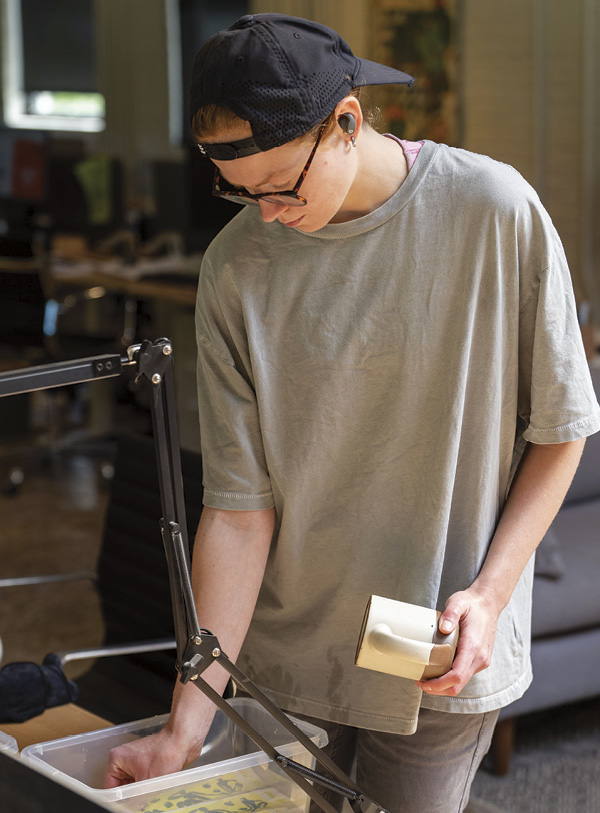 next?
next?
KJ: I’ve learned nearly all my technical skills at East Fork. The growth I’ve experienced over the past four years has shaped how I work in every part of my life. I’ve developed strong problem-solving abilities, physical endurance, administrative responsibility, and meticulous attention to detail—especially on projects where 40 hours of work can fail within minutes, and having to reset and start again. I’ve earned practical certifications in forklift and CPR, and gained hands-on skills in safely using sledgehammers, heavy machinery, and heavy lifting. But most importantly, East Fork gave me confidence that I can learn any craft, adapt quickly, and master new skills.
CM: What drew you to East Fork, and how has your role here evolved over time?
Emma Whitney: I was drawn to East Fork for many reasons. However, in the spirit of complete honesty, the starting pay was higher than most of the other jobs I would have been qualified for at the time. During my interview, it became evident that this company was dedicated to its craft in a similar way to my previous job in woodworking. I started at East Fork as a glaze generalist and quickly realized that this company offered far more than just a living wage; it is a business that truly values the growth of its employees. As I learned more about glaze setup and application, I was promoted to a glaze team lead. And as I learned more about kiln firings, rheology, and the function of the equipment we use daily, I moved away from the glaze team and into a materials technician role, gaining a technical understanding of glaze calculations, color and clay development, material interactions, process improvements, kiln firings, and so much more. My role is now focused on developing East Fork’s glaze colors and products.
CM: What skills have you learned at East Fork that you think will stay with you, regardless of where your career goes next?
EW: There are a plethora of technical and management skills East Fork has taught me over the years, from methods of data collection, recording, and interpretation to quick decision-making and on-the-job problem solving. East Fork has also taught me that success is rarely achieved alone. Instead, it’s achieved by uplifting those around you and showing up with compassion and an unwavering dedication to be the best that you can be.
Photos: East Fork.
Must-Reads from Ceramics Monthly
Unfamiliar with any terms in this article? Browse our glossary of pottery terms!
Click the cover image to return to the Table of Contents