
Darlene Pratt
Darlene Pratt Studios
Ontario, Canada
Email
Website
Instagram
@darleneprattstudios
Facebook
Artist Statement
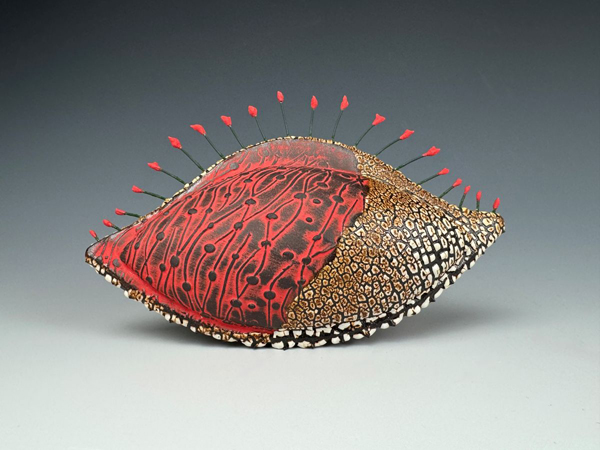
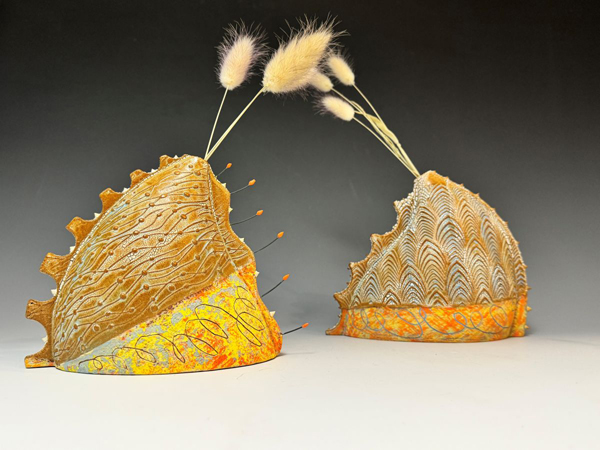
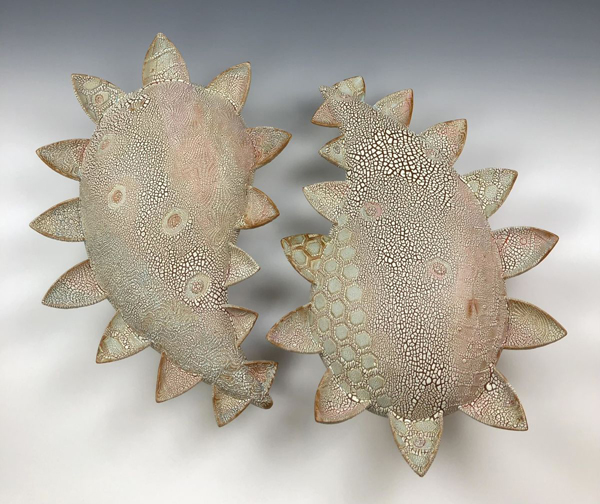
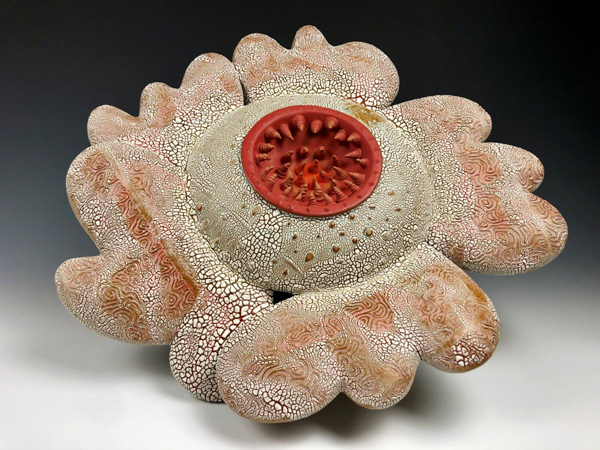
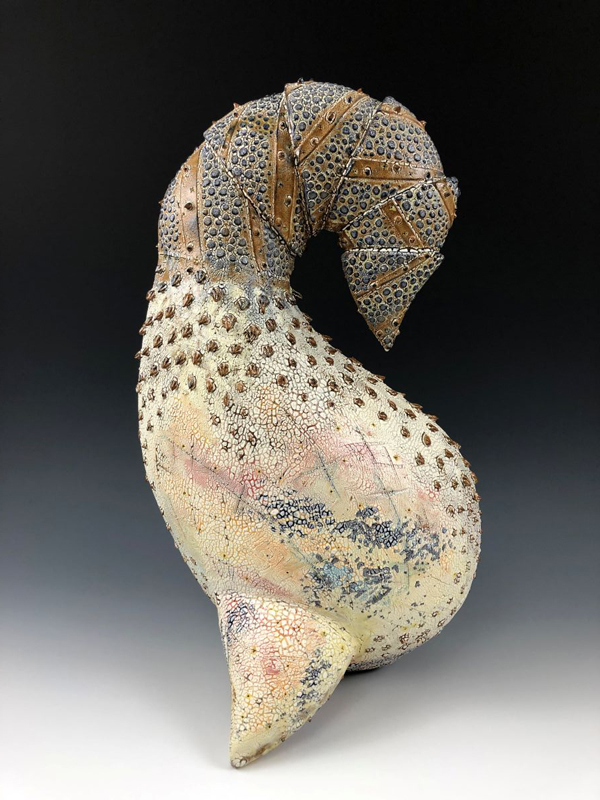
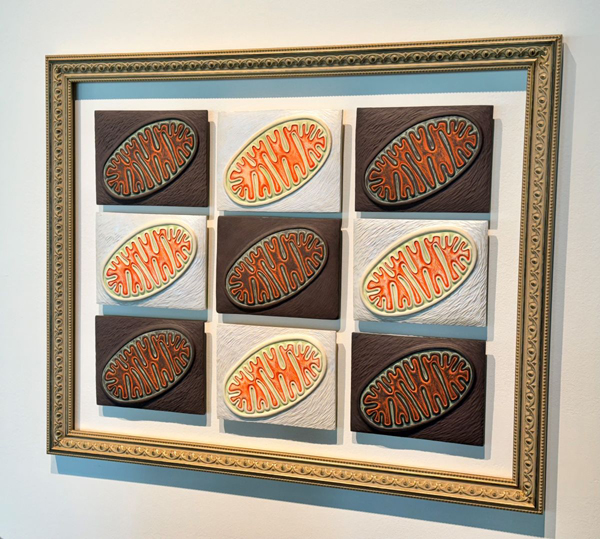
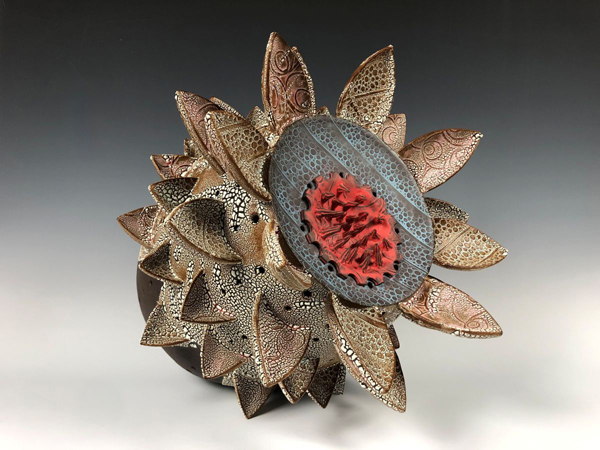
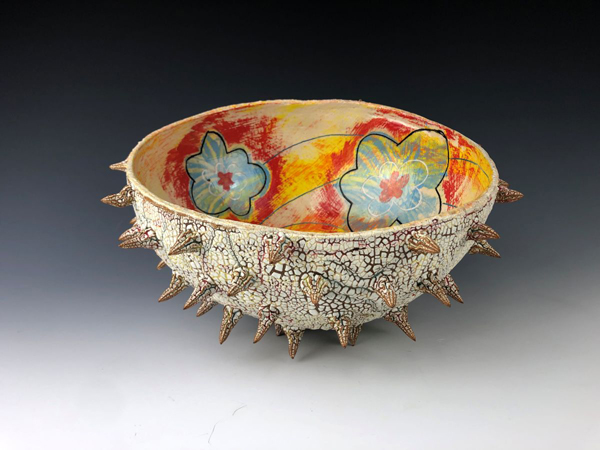
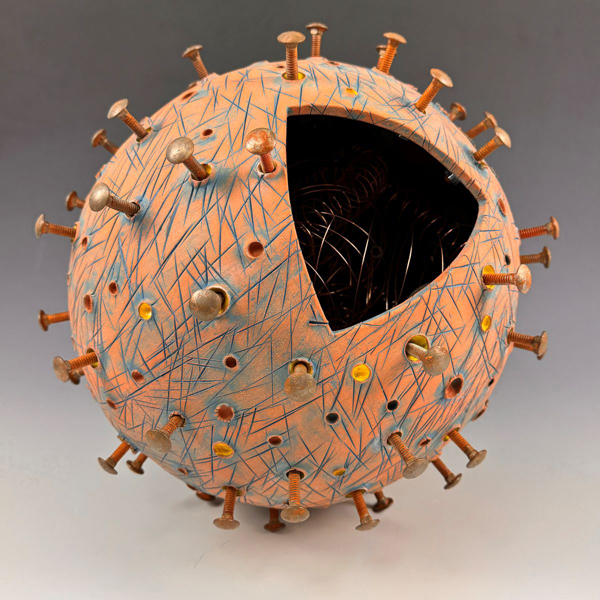
Inspired by architecture, electron microscopy, insects, succulents, and sea creatures, Darlene weaves into her ceramic work the principles of design and engineering observable in both human-made and natural structures. Her organic forms are in a state of tension with the mechanical textures stamped into the clay and the colours that lay beneath and peek around the edges of the lichen glaze she often uses. Darlene’s work feels familiar and alien, compelling intimate examination of the surfaces, visually and through touch. Animalian, yet reminiscent of plants, and of fossils, her pieces could be objects of the past, present, or future.
Studio Description
I work in the lower part of my home, which is on grade with a sliding glass door to a small outdoor garden. My studio is 12ft X 14ft or 168 square feet - not large but certainly better than nothing! I count myself fortunate to be able to work at home and move freely between my living and creative spaces.
What type of clay do you use?
Various cone 6 clays including Tucker's Dark Mid-Cal 5 and Mid White, as well as Pottery Supply House's 540i Black, Dark Granite, and 519 White.
What temperature do you fire to?
Cone 6
What is your primary forming method?
I cut shapes into firm cardboard boxes for slump molds to make voluminous forms that I can cut and attach to create simple or complex pieces.
What is your favorite surface treatment?
I love the combination of texture pressed into the clay, colourful underglaze layed into the textural depressions and then overlayed with lichen glaze.
Do you make any of your own tools?
I make my own molds from firm cardboard boxes, and I make some of my own texture rollers using PVC pipe or firm cardboard rolls and a hot glue gun, or bisque-fired clay.
What one word would you use to describe your work?
Esemplastic
What is your favorite thing about your studio?
I love that my studio is in my home. My home studio allows me to work in short spurts when my time is especially scarce, which helps me stay connected to the work and oversee its demands vis a vis drying time and attaching pieces at the optimal moment.
What is the one thing in your studio you can’t live without?
My surform blades! I will deliberately imagine projects that allow me to use my surform because I find the process very sensuous, hypnotic, and highly pleasurable, as well as precise and effective.
What are your top three studio wishes?
More space that will allow more efficient workflow, a selling space, and teaching space.
What’s on your current reading list?
Art Forms In Nature by Ernst Haeckel, and Crossing Over: Where art and science meet by Stephen Jay Gould and Rosamond Wolff Purcell
How do you save money on materials and supplies?
I reclaim all my clay and submit entries, the prizes for which can be materials and tools from our local ceramic suppliers.
How do you recharge creatively?
By looking closely at natural features such as flowers, rock formations, and insects. I get very excited about architectural structures, figuring out how they were built and gaining insight into the creative minds behind them.
Do you have any DIY tips for studio efficiency?
I transport greenware across town using copious plastic bags as the cushioning medium in cardboard or plastic containers. Ideally, I don't allow the work to dry completely before transporting.
What challenges have you given yourself to overcome?
In terms of technical challenges, I am thinking about how to make larger and larger pieces (architectural) within the limitations of the kiln in which I fire. I am thinking modularly to achieve the ideas I have in mind.
What did your first piece look like?
My first piece was a handbuilt, straight-sided mug with a carved triangle and a circle along with this sentence, "Ceci ce n'est pas une triangle, ni est elle une cercle", referencing Rene Magritte's famous painting Ceci n'est pas une pipe.
What ceramic superpower would you have and why?
I would have the ability to stop pieces from ever breaking because the fear of their fragility and ephemerality keeps people from using them, and therefore enjoying them, to their fullest potential.
What area of skill do you most look to other artists to learn?
Innovative construction techniques, interesting tools to facilitate complex forms.
Who is your ceramic art mentor and why?
In 2020, after a 15-year hiatus from working with clay, I entered a creative mentorship with Lesley McInally whose rich mono-printed surfaces I admire. She helped me find a new voice in texture and sculptural form.
What is on your studio playlist?
Lord Echo, Khruangbin, Maribou State, The XX, Aurora, and any House music
Why do you create art?
Art creation helps me explore, learn about, and make sense of the world, as well as to understand who I am in the vastness of the universe.
Who is your favorite artist and what do you admire about that artist?
I admire the sculptural work of Louise Bourgeois, and saw one of her "Mother" pieces at the Bilbao Guggenheim in 2016. Her work is powerful and technically impressive.
What is your best studio tip?
It isn't necessary to have all the latest and fanciest tools to create good work.
If you could change one property of clay, what would it be?
I would make ceramics more resilient to concussive force.
Click the images to enlarge them. Click the Esc key to close.